I’m featured in the voiceover of this trailer for the forthcoming documentary TERF Island! You can hear me reflect briefly on the limitations of trans liberalism, as well as the threat posed to the cis / sexist world order by the possibility of real liberation.
TERF Island will explore trans people’s every lives in the UK, looking at everyday experiences of art, culture, and community against the backdrop of rising hatred and discrimination. I have contributed by sharing some of my research with the creators at Hissing Goose Films. The film also features contributions from a range of amazing groups and people, including Cheap Dirty Horse, transkaters, Tribe Incorporated, CAMP Wrestling, Olivia Campbell Cavendish, Jazmeen Qureshi, What The Trans, and Shivani Dave.
Hissing Goose are now crowdfunding to finish off the film. You can learn more here.
Please do share and/or donate to the crowdfunding page if you can!
I am super excited and honoured that some small pieces of my own punk history are featured in the new exhibition Grrrl Germs: Feminism Goes Viral, curated by Astria Suparak.
The exhibition runs until Sunday 29 November at the Great Park Gallery in Irvine, and is free to attend. It also featured at the inaugural Daisy Chain Fields festival.
If you (unlike me) happen to be in California, you can see displays that include posters from three gigs we played with my old band Not Right: Ladiyfest Sheffield in 2013, the Riot Grrrl Valentine’s Ball in Brighton, 2014 (with our friends Big Joanie, among others), and Revolt #7 in Coventry, 2014.
The latter poster was one of several I designed for Revolt, a feminist club night which ran in Coventry from 2012-2017 – I was part of the organising collective along with Not Right guitarist Kirsty Lohman. It features an image of Beverley Ishmael, drummer for The Tuts, who headlined that gig. You can see a bit of this poster in the top left corner of the super cool flyer for Grrrl Germs!
I say this is part of “my” personal history, but the really great thing about the exhibition from what I have seen is that it explores feminist punk as a collective activity: something that so many of us have done together, across the world and over the decades. I think that’s a very beautiful thing. Here’s to our shared pasts, and the futures we are still building together.
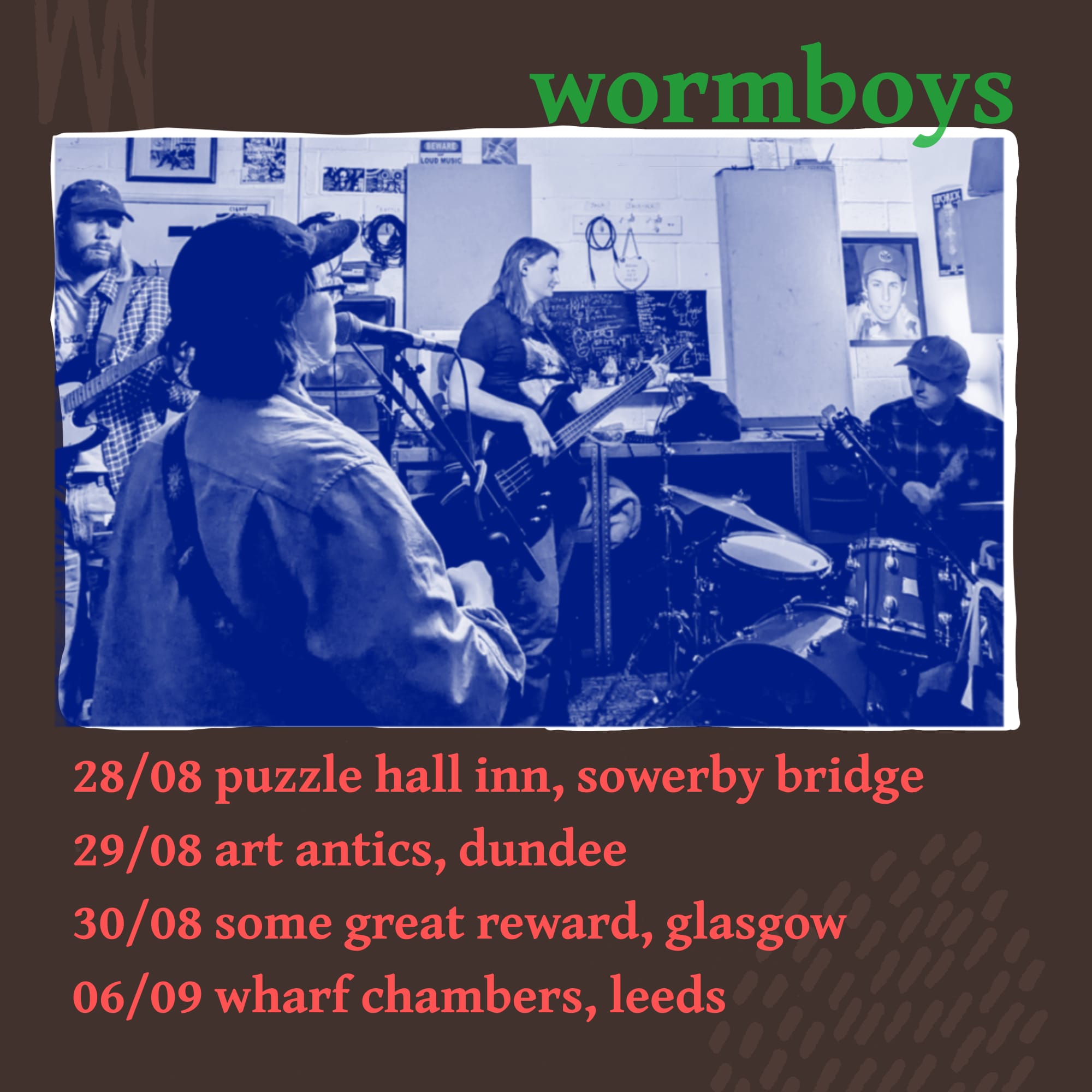
Soon we will be embarking on a short summer tour with wormboys! You can see us play the following places in the last week of August and first week of September. Catch us if you can!
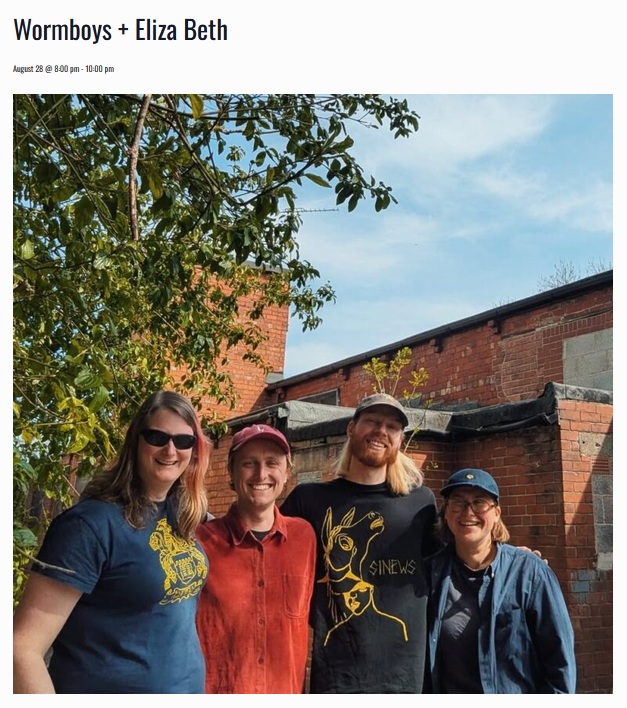
28 August 2026 – Puzzle Hall Inn, Sowerby Bridge Gig from 8pm. Read more here. Free event! With Eliza Beth.
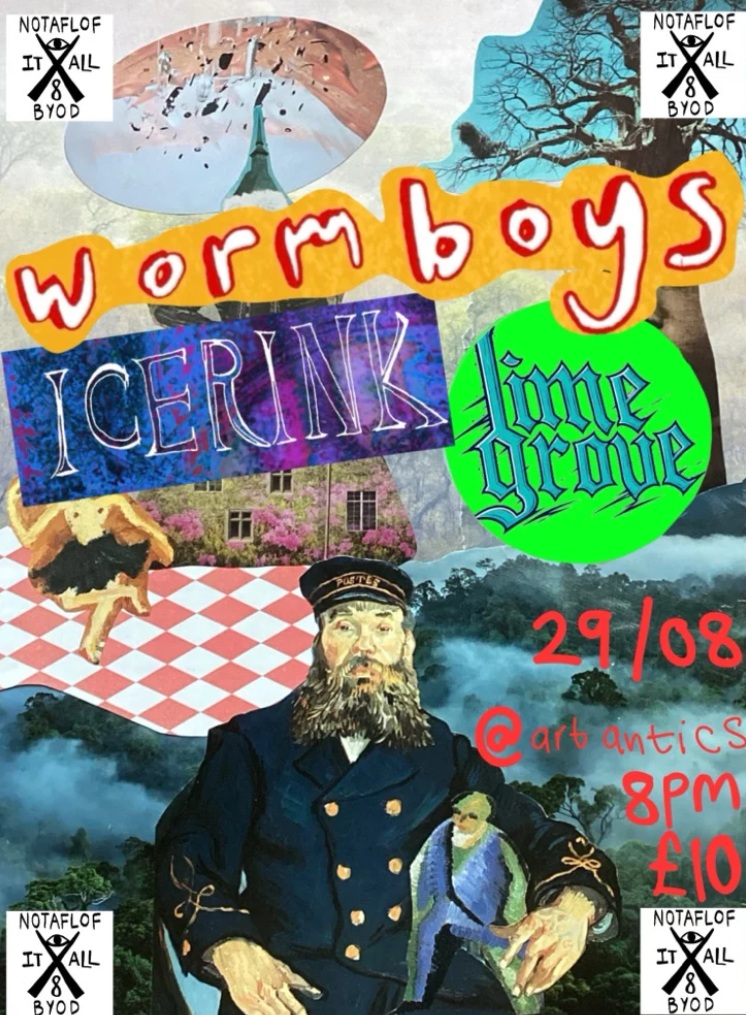
29 August 2026 – Art Antics, Dundee Doors 8pm. Buy tickets here. With Icerink and Lime Grove.
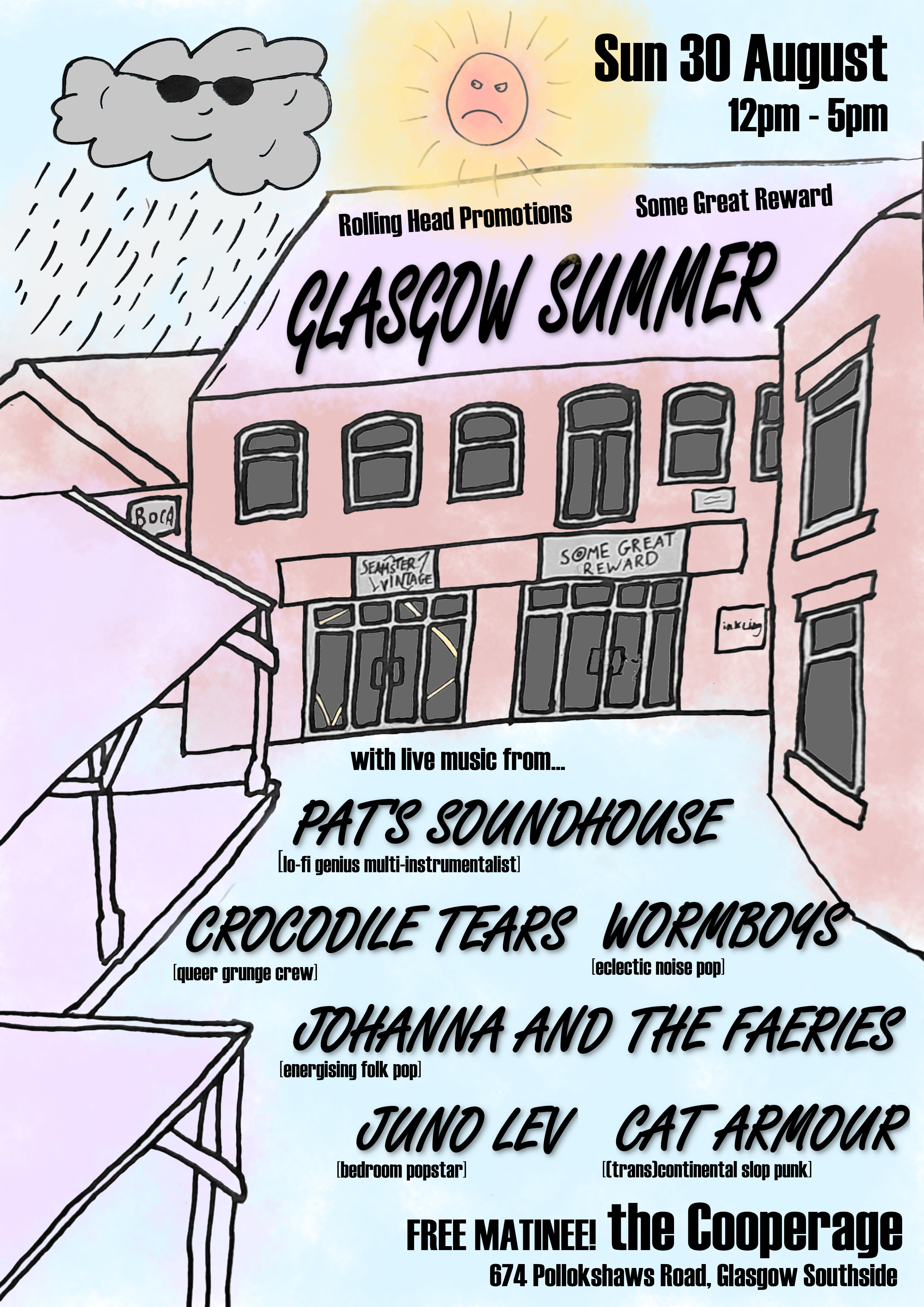
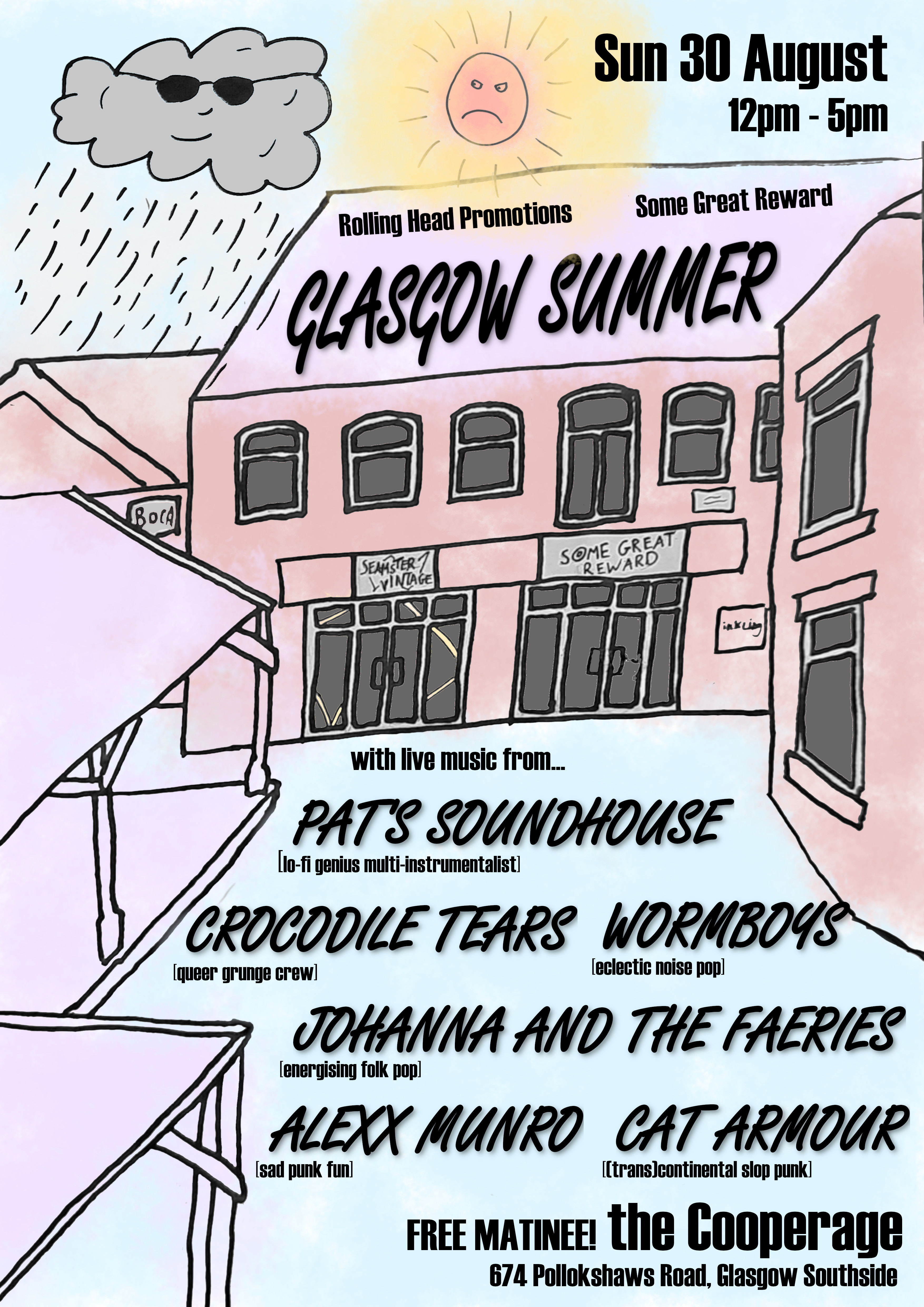
30 August 2026 –The Cooperage,Glasgow 12pm-5pm. Read more here. Free event! Glasgow Summer – all ages matinee show. With many other acts.
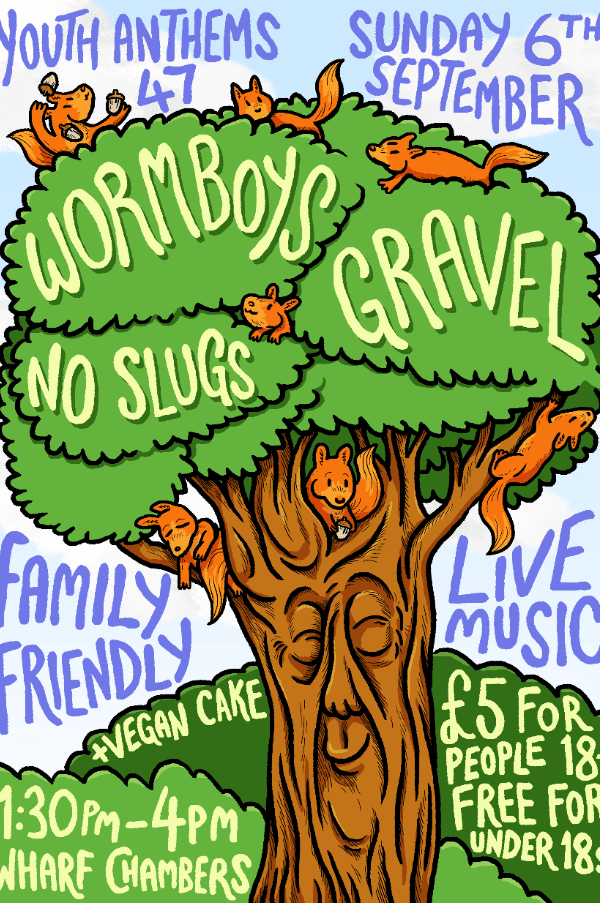
6 September 2026 – Wharf Chambers,Leeds 1:30pm – 4pm. Buy tickets here. Youth Anthems – all ages, family-friendly matinee show.With Gravel and No Slugs.
We’ve also got other shows coming up in the likes of Leeds, London, and Sheffield over the coming months.
It was the largest trans protest in British history.
We travelled from across the country to central London. We were joined by allies, especially cis gay, lesbian, bisexual, and queer people who recognised the importance of solidarity, of standing together in this moment. Wielding bright flags and banners, we gathered in unprecedented numbers. We to were here to raise our voices against the institutionalisation of transphobic hate and abuse, to oppose calls for exclusionary policies and trans healthcare bans.
I couldn’t possibly miss this, so travelled down on the train from Leamington Spa with my home-made placard. Looking around after I arrived on that cold winter night, I marvelled at the sight. There were so many of us. Maybe as many as 150, or even 200! And my friend Jo even brought a home-made trans flag with them, which was an amazing thing to see outside of the internet.
The year was 2008, and we assembled outside the Victoria and Albert Museum to protest the annual Stonewall Awards. The UK’s largest LGB charity had nominated the Guardian journalist Julie Bindel for an award, despite – or perhaps even because of – her notorious transphobia. The protest was called by the London Transfeminist Group, and supported by a range of other organisations, including Queer Youth Network, Trans Youth Network, and the National Union of Students (NUS) LGBT Campaign.
Afterwards, we gathered at a local pub and talked excitedly. The protest was a massive embarrassment to Stonewall, and through grassroots organising we had shown we could bring trans people and allies together on a scale that never before felt possible.
How could we build on this power, and what might the future bring?
***
It was the largest trans protest in British history.
Trans people travelled from across the country to central London. They were joined by allies, especially cis gay, lesbian, bisexual and queer people, plus parents and family members, trade unionists, and celebrities who recognised the importance of solidarity, of standing together in this moment. Wielding bright flags and banners, they gathered in unprecedented numbers. They were there to raise their voices against the institutionalisation of transphobic hate and abuse, and to oppose exclusionary policies and trans healthcare bans.
Photo by Aaron Chown/PA. Compare and contrast…
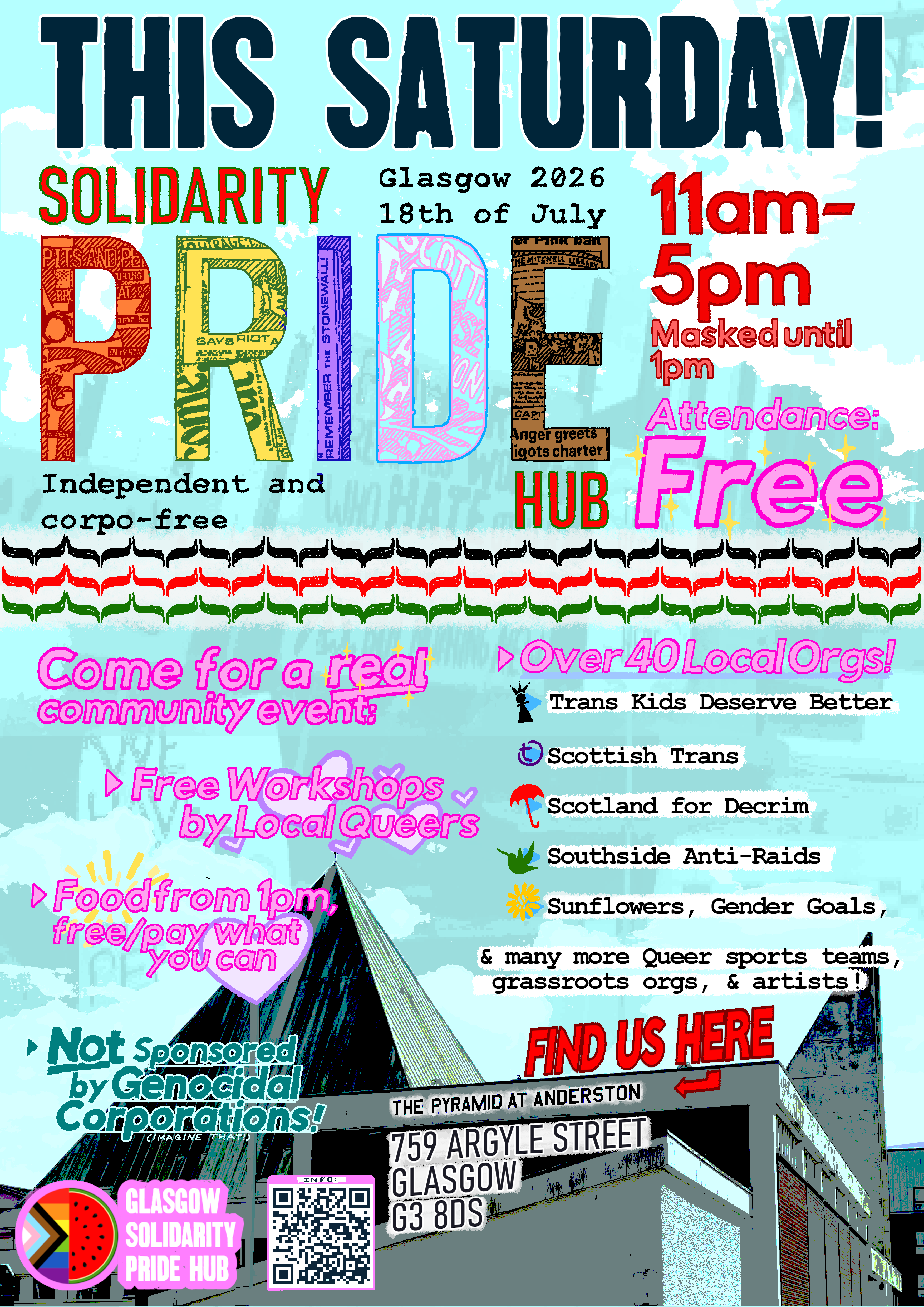
I wasn’t in London for Trans Pride 2026. I’m involved in plenty of protests and community events in Glasgow these days, from last year’s noise demonstrations outside the EHRC headquarters, to the incredible Solidarity Pride Hub, which filled the Pyramid at Anderston with amazing talks, workshops, and stalls led by trans and queer organisations. Nevertheless, watching online as the images came in was pretty incredible. A reported 150,000 people took to the streets, just one week after thousands more gathered for Trans Pride Brighton.
How can we build on this power – and what might the future bring?
***
For decades, the trans liberation movement has fought to change the world. We found new ways of being, and created language, art, and culture to name and explore these possibilities. We won new civil rights. We achieved incremental improvements in the provision of healthcare and education. We have made it a fair bit easier for many people to exist in the workplace, and to survive on benefits. We have built community: feeding each other, housing each other, and providing advocacy for each other, and partying together.
For all the achievements of the trans liberation movement, many of us have continued to struggle enormously in the face of interpersonal and institutional violence. This is especially the case for those more likely to be left behind by liberal trans activism, including disabled trans people, trans migrants, trans people of colour, and trans sex workers. Trans communities have also handily replicated the structural misogyny of the wider world. As a result, paid roles in advocacy, charity work, and the arts remain dominated by trans men and transmasculine people.
Meanwhile, through becoming more visible, we have become more vulnerable. Through being acknowledged within institutional frameworks, we have become more identifiable. Through asking for respect, we have become a problem. Through entering political conversations, we have become scapegoats.
Cis “centists” are often swift to blame trans people for our own problems. If we’d just been more polite, more accommodating, and less demanding.
Trans people also frequently assess our movement’s activist strategies. Sometimes this will be helpful. For example, there are lots of productive discussions happening right now about the respective merits of lobbying people in power vs building power in our communities from the ground up. Other times, certain trans people will say we have gone too far, demanded too much. If only we’d been more respectable. If only we’d laid off the pronouns. If only we could agree on a nice, clear definition of “trans”. If only we gave up on those confusing non-binary identities. If only we’d let children be children.
***
I came out to myself and my friends while in school, transitioning as a teenager in the early 2000s. I cannot emphasise enough how unusual this was – and consequently, how lonely and isolating my experiences were. We had so little information. Most out trans people at this time were middle-aged or older, and I didn’t have any opportunity to meet them. Being a trans teenager felt like a complete impossibility.
My transition had three key enablers. The first was my own sheer bloody-mindedness. The second was the support I did find and receive from others. And finally, I benefited from an enormous dose of luck.
After years of fruitless online searches for anything that would explain my feelings and my needs, I found a US web forum run by and for young trans people, providing invaluable advice and a sounding board. I wasn’t sure at the time whether I was a real transsexual, or just one of them fake cross-dressers. The broad, fluid language of transgender identity and experience meant that this artificial distinction didn’t actually matter. The important thing was solidarity: gender diverse people standing together in the name of our shared interests. This enabled me to explore what I might need and desire in an open-ended way with other people my own age, without feeling that I had to transition in any specific way or on any particular timescale.
In the offline world, none of my teen friends understood what I was going through. But they supported me unconditionally. My early romantic partners also had my back. One took me shopping, and helped me figure out my style. Another gave me my name.
I first went to see a doctor for help with medical transition aged 15, but I failed to receive a gender clinic appointment until I was an adult. This didn’t feel lucky at the time, but looking back, it was an enormous stroke of fortune. Through spending years on waiting lists, I avoided the conversion therapists who then – as again now – dominated child and adolescent services.
During these teen years, a schoolteacher – unable to provide me direct advice herself due to Section 28 – referred me to a free counselling service provided by a local charity. I remember my counsellor asking me, “do you think you are part of oppressed minority?” I wasn’t quite sure. Maybe? Probably?
Given the luck I had experienced, I did not understand how much I had already been let down. I did not fully comprehend the sheer void of information on trans existence. I did not realise that my self-hatred and self-denial was the fault of damaging social norms and expectations, rather than something broken in me. Nor did I understand how massively vulnerable I was as a result. The support of my peers meant that unlike many other young trans people, I was not subject to sexual predation: a topic later explored in my research, plus stories such as Paris Lees’ autobiographical book and TV series What It Feels Like For A Girl. I did not see how much my own internalised sexism had already warped my sense of what might be possible for me, leading me to take on a passive role in friendships with male friends who I watched play music and video games. And while I had already been beaten up or groped multiple times in the playground and the street, I was yet to experience much of the targeted transmisogyny that would accompany me into adulthood: the continued sexual assaults, the verbal abuse, the harassment, the stalking.
I didn’t know it at the time, but what I needed was trans community, and feminism.
***
I became an activist in the mid-2000s, during my early 20s. Again, a few chance events spurred me along. But I also benefited from the care and energy of others who wished to change the world.
One of the first trans people I knowingly met in person was the professional speaker and advocate Rikki Arundel. A young gay man had booked them to speak for a student event at the University of Warwick, where I was studying for my undergraduate degree. Rikki took me to a café immediately after the talk. “So”, they asked, “you want to be a trans activist?” I hadn’t asked.
Rikki nevertheless spent some time outlining advice. Get to know people in your area: community members, local politicians, policymakers. Go to meetings and become known. Build a reputation as a helpful and reliable point of contact. At every possible opportunity, leverage this to demand change, positioning it as a sensible, reasonable course of action.
Rikki’s advice was invaluable for working within liberal systems. These days, I am wary of trans liberal approaches, as these can be individualising, and lead to concessions that leave many behind. But you do not need to believe in or support a system of power to work within and against it.
Around this time I also went to my first NUS conferences. Through the NUS LGBT Campaign and later also the NUS Women’s Campaign, I shared knowledge and skills with other young people, and went to my first protests. Through these campaigns I met other young, openly trans people in person for the first time, including Mallory Moore. I learned great deal from organisers such as Mallory. They appeared to have very different beliefs to Rikki, but were, in fundamental ways, doing very similar work. Get to know people. Build connections. Identify points of common interest. Figure out where and how to apply pressure to achieve change. Where Rikki spoke to the local council, Mallory worked with local feminist groups. I found myself doing both.
***
The isolation of my teen years continued into my early adulthood. Encounters with people like Rikki and Mallory were fleeting, one-off events. I would then go entire months without knowingly meeting another trans person.
To break this isolation, I began to travel. I took a day trip to Birmingham to hang out with a slightly older trans youth activist from Queer Youth Network, an internet community I’d recently joined. I travelled to Bradford and Manchester to speak at student union meetings, arguing for the introduction of all-gender toilets. I travelled down to London to attend an event hosted by a new organisation called Gendered Intelligence, and marvelled at being in a room with over a dozen other young trans people. This event wasn’t actually very good: it only happened because it had been funded by cis academics who wanted to do some boring research. But I left to sit in the corridor and chat with other trans girls, who would become lifelong friends.
There were so few of us out because there was still so little information available, and so little in the way of community support for those who did try to come out or transition. Most trans people were spending years, decades, lifetimes stuck in the closet. But this was beginning to change.
Trans communities in the UK were benefiting from a virtuous cycle of coming out. The internet helped a great deal with this, as new resources and information spread online. But the real change came with trans people simply being a visible part of public life. Transphobes like to call this “social contagion”. I prefer Laverne Cox’s term, “possibility model”. You see a trans person getting on with their life, and realise that sex change is possible for you, too.
In so many spaces, I was patient zero for the viral spread of trans possibility. I cracked eggs everywhere I went. Every time I spoke at an event, or attended a conference, or hung out with other queers at the pub, I showed that another world was possible. Young trans people came out all around me, and in turn they became visible to others.
But coming out is just the first step. For trans lives to be liveable, we need support from other people. We need to share resources and information. We need community.
***
I remember speaking in the late 2000s or early 2010s with an older trans woman at an event in Wolverhampton. Following the repeal of Section 28 some years before, she was keen to work with schools to ensure that young trans people were never as isolated and confused as I once was. “We need education at an early age”, she said.
We did this. It was not the action of any one person or group at any moment in time, but the action of a movement across many years. Organisations like Schools OUT produced material and information for schools. Groups like Gendered Intelligence helped support the development of a knowledge base to evidence change. Individuals like myself spoke with our local councils about how they could change their policies. Thousands of teachers across the country quietly changed their curricula, introduced new approaches, and created clubs for trans and queer kids.
Meanwhile, others created blogs, youtube videos, social media posts that circumvented schools entirely, speaking directly to young people. Importantly, much of this material sought to break away from the old binaries that used to divide trans communities: male-to-female vs female-to-male, transsexual vs transvestite. With “trans” we were imagining solidarities across difference, a context in which those who did not seek medical transition sought commonality with those who did, and vice-versa. We were collectively imagining a world in which sex norms and gender stereotypes no longer governed our lives, and in which we might work together to achieve our varying desires and needs.
It is interesting to think about this former progress at a time when the UK government has produced incredibly transphobic new legal guidance for English schools, and when NHS England is actively pushing conversion practices. Trans kids now face an incredibly hostile policy environment: one that refuses to even name their existence even as it demands that they be segregated and abused.
Yet, young trans people continue to come out, to seek support and support one another, in numbers that would have been inconceivable to the protesters gathered in London on that cold night in November 2008.
***
The strange irony of trans life in the 2020s is that there are still more of us than ever. Even as external conditions become more and more hostile, the virtuous cycle continues.
Some of this is about possibility models. You can see this in Trans Pride London 2026. We are talking 150,000 possibility models on the streets in central London in one day alone. Every single one of these people sends a message to those thinking about coming out. That message says: you are valued, you are loved, and support is available. You are not alone.
Some of this is about trans-led support. While the NHS, crisis services, shelters, housing services (etc etc) have variously got better and worse over the years, they have always let many of us down. In light of this, trans people have built mutual aid networks to get vulnerable people out of dangerous accommodation, house those in need, produce and share medication, and disseminate harm reduction resources. In this context, trans diversity is vital: we need strong communities that are more interested in how we might bring our myriad of skills and experiences to bear in caring for one another, rather than obsessing over how our language and identities might differ.
Some of this is about trans art and culture. You can turn on the TV and see trans actors, comedians, politicians, and experts, on shows written or produced by other trans people. You can turn on the radio and hear trans people playing music or speaking about their experiences. In some towns and cities, you can even can go to your local gallery and see work by trans artists, visit your local pub or club or DIY venue and see trans performers, and they might even give out handy little flyers telling you where you can get your hands on HRT.
Some of this is about solidarity work from cis people. All that endless work of education over the past decades has not been in vain, however much the politicians and hateful people of this world would like it to be. Through incessantly speaking out and demanding change, and in joining with others to support their struggles, trans people have made allies everywhere. Teachers and lecturers, doctors and nurses, administrators, hospitality workers, lawyers, and many more are more likely to have access to information through their family or friends or trade unions, which help them in turn to support trans people in a hundred thousand little ways every day.
***
In 2008 we found hope in the possibility of community connection, solidarity, collaboration, and friendship. In 2026, we see what was successfully built from that hope and that possibility.
Over the last two decades and beyond, we have won trans community and connectivity on a scale that was once unthinkable. We have made allies across every part of public life. We have helped hundreds of thousands people to improve their lives. This is a historic achievement.
Today, the trans liberation movement faces off against vicious foes and their allies in the Labour government, who would see us eliminated altogether. Trans people of all ages and backgrounds are forced to navigate laws and policies designed to make our lives more difficult and more dangerous.
It is all too easy to think that the trans activism of the past has failed, that every gain has been reversed in an orgy of hate and bigotry. Yet this is simply not true.
The achievements of the past have helped prepare us collectively for the demands of this moment. There are more of us than ever, and we have successes as well as failures to learn from.
Following the success of A gig for Isaac(and it was a huge success! we raised £800), I’m very excited to announce Glasgow Summer, on Sunday 30 August.
I am fully back my nonsense, once again co-organising the gig and playing a set with wormboys. Because why not. Also I made a ridiculous poster, for which I am sure you will observe precisely zero genAI was employed.
There’s no specific cause this time. Or rather, the cause is: good music, good times. And it will be completely free to attend! We (Rolling Head Promotions) have teamed up with the fantastic Glasgow Southside record store Some Great Reward, who are supporting us to host the afternoon gig in the outdoor courtyard at The Cooperage (complete with a good bit of cover in case of rain).
The event will feature live folk, punk, pop, and grunge music from:
Pat’s Soundhouse Legendary bedroom pop multi-instrumentalist – stepping out of the bedroom and into the street (well, courtyard) for this very special occasion!
Accessibility: The Cooperage is an outdoor courtyard location, with level access from Pollokshaws Road. The entrance does however feature somewhat uneven pavement and pavestones: you can see an image of this on google maps here. The courtyard has paving, gravel, and a handful of benches – you can see photos on the Cooperage website.
This will be an outdoor gig, although if there is much rain forecast we should have a marquee (obviously if there is a horrendous thunderstorm we will have to cancel). Food and drink is available from many local outlets, including the Cooperage’s very own Boca sandwich shop. All-gender toilets will be available, including an accessible toilet at Boca until 4pm.
My workshop will take place during the afternoon for about an hour (timings TBC). I’ll be focusing specifically on techniques for addressing a demonstration or public meeting. It’ll be very interactive, and I’ll be encouraging participants to discuss ideas, and practice techniques together for breathing, projecting, and annunciating (without losing your own accent or style).
The wider event is going to be super cool, with loads of amazing workshops, stalls, and food produced by local queer organisations.
I entered the board room with some trepidation, amidst a gaggle of nervous colleagues. We were followed by the LGBT Equality Champion, and the Interim Head of Equality, Diversity, and Inclusion. The room itself was relatively mundane. Some chairs sat around a set of rectangular tables. A blank screen was linked to a computer in the corner. It could have been any room in the institution – if it were not for the view.
We were on the top floor of a shiny new building. Through floor-to-ceiling glass windows we could see a magnificent sweep of the city. I admired the soaring gothic tower of the university, the busy streets nearby, and the new blocks clustered around the river. A long march of tenement buildings to the south was ended by a wide semi-circle of high hills, with wind turbines working busily atop them.
We had gathered in this room to discuss national proposals for the mandatory segregation of trans staff and students. My colleagues had asked for the meeting to explore what – if anything – our employer might be prepared to do to counter these damaging proposals. We had taken time out of our busy schedules. There was no accounting for this in our workload. There was no guarantee we would achieve anything of use. We were concerned about the impact of the proposed segregation scheme on our work lives – but also about the impact of the meeting itself upon our wellbeing.
All of us, aside from the institutional equality leads, were trans ourselves. Many of us had previous experiences of equality schemes, having put countless hours into discussions intended to reshape policy to the benefit of minoritised staff and service users. We often felt isolated and bogged down in such conversations: finding it hard to explain the urgency of action, struggling to translate ideals into action, and fearing that we would be positioned as troublemakers.
As we sat down together, I found myself thinking about Toby Odland’s framing of the second law of thermodynamics:
Some input of energy is required to go between states of non-movement and movement. In large scale systems some of the energy put in to get an object to change state will be dispersed as heat into the environment. Not all of the energy put in is transferred to kinetic or static energy as may be the desire of the one providing the input. In other words, work wastes energy. (29)
In that room with the beautiful view, I was painfully aware of how inequalities can be reproduced in interventions designed to combat them. This phenomenon is a central concern of Toby Odland’s doctoral dissertation, Re-framing in friction: on Trans-inclusive enactment of gender equality aims. The dissertation offers a phenomenological interrogation of how gender inequalities persist for trans people in institutional environments, despite efforts to identify and tackle them.
The above is an extract from my review of Toby Odland’s PhD dissertation Re-framing in friction: on Trans-inclusive enactment of gender equality aims. You can read the full review, published in Tidskrift för genusvetenskap, through either of the links below:
I was asked to write this review after acting as opponent in Toby Odland’s doctoral defence at Linköping University in Sweden, in June 2025. Unlike the UK’s PhD vivas – oral examinations which take place behind closed doors – Swedish doctoral defences are public events, usually taking place at a point where a committee of experts has already supported the provisional completion of the PhD. As such, the dissertation is distributed in print and in digital format ahead of the defence. You can download a free copy of Odland’s dissertation here.
The opponent’s role in a public defence at Linköping University is to present a short summary of the doctoral student’s work to the audience, before asking the student a series of scholarly questions about the work and its implications (you can download my presentation slides here). The student then takes questions from the audience, before an examination committee convenes to (hopefully!) confirm that the PhD should be awarded.
As you’ll see in the full review, I was extremely impressed with Odland’s account of gender equality work in Sweden, and I believe it will be highly relevant reading for people involved in equality work in other countries too.
The UK is currently sweltering through the hottest June on record. The Met Office has issued a “red warning” for much of England and Wales, highlighting an active danger to life. Trains have been cancelled, roads are melting, and we will likely see more deaths in coming days. Yet the media is talking little about climate change. Instead, one of the big stories of the week is that businesses and unions are uniting in opposition to the proposed appointment of Ed Milliband as Chancellor of the Exchequer, due to the belief that he is too committed to “net zero” emission targets.
How did we get here? And why are trans people once again to blame?
I have a new short article out in the International Journal of Feminist Approaches to Bioethics. It is co-authored with a range of international colleagues, variously originating from and/or based in Australia, Canada, Chile, Finland, Germany, the Netherlands, Switzerland, and the USA, as well as the UK. You can read it here:
In the article, we examine how evidence is being misused in debates and policy relating to sex and gender. Our authorship team holds expertise in a range of topics and disciplines, including figures such as clinical psychologist Dr Tomás Ojeda, neuroscientist Dr Dori Grijseels, criminologist Professor Sarah Lamble, and the sociologist and former Olympic athlete Dr Madeleine Pape (to name just a few!) We met at last year’s workshop on sex and gender policy at the University of Lausanne, and have been collaborating ever since.
Drawing on examples such as the UK’s Cass Review and Sullivan Review, US state hearings, and the global exclusion of trans women from sports competitions, we collectively identify six common pitfalls in the use of evidence:
presenting “expert” opinion as authoritative
excluding relevant expertise, especially from trans people
discrediting scientific consensus
setting unattainable standards
deploying decontextualized claims
positioning disinformation as science
We focus especially on how this misuse of evidence in sex and gender policy is causing direct harm to trans people. However, we also note the dangers for other contexts. Given the typical misogyny of anti-trans discourse, this of course includes all women, plus intersex people.
We further highlight how the strategies developed for undermining and misusing evidence in sex and gender policy can also inform a more general distrust of scientific endeavour. In the USA, this can be seen in the mass defunding of scientific programmes and institutions, which we note in the article. Here in the UK, examples include widespread disinformation about immigration, which is being used both to fuel and excuse racist policies and fascist riots… and of course, also public attitudes and policies on climate change.
I hope our new article will be a helpful tool for people wishing to identify and understand how evidence is misused and ideology prioritised – in sex and gender policy of course, but also in wider public debates.
Did you appreciate this post? Want to read more?
Subscribe now to receive new posts for free whenever I write them.
We have several very exciting wormboys shows coming up over the summer, the first two of which have been announced. Both will be in Wharf Chambers, the most excellent venue in the most excellent city of Leeds.
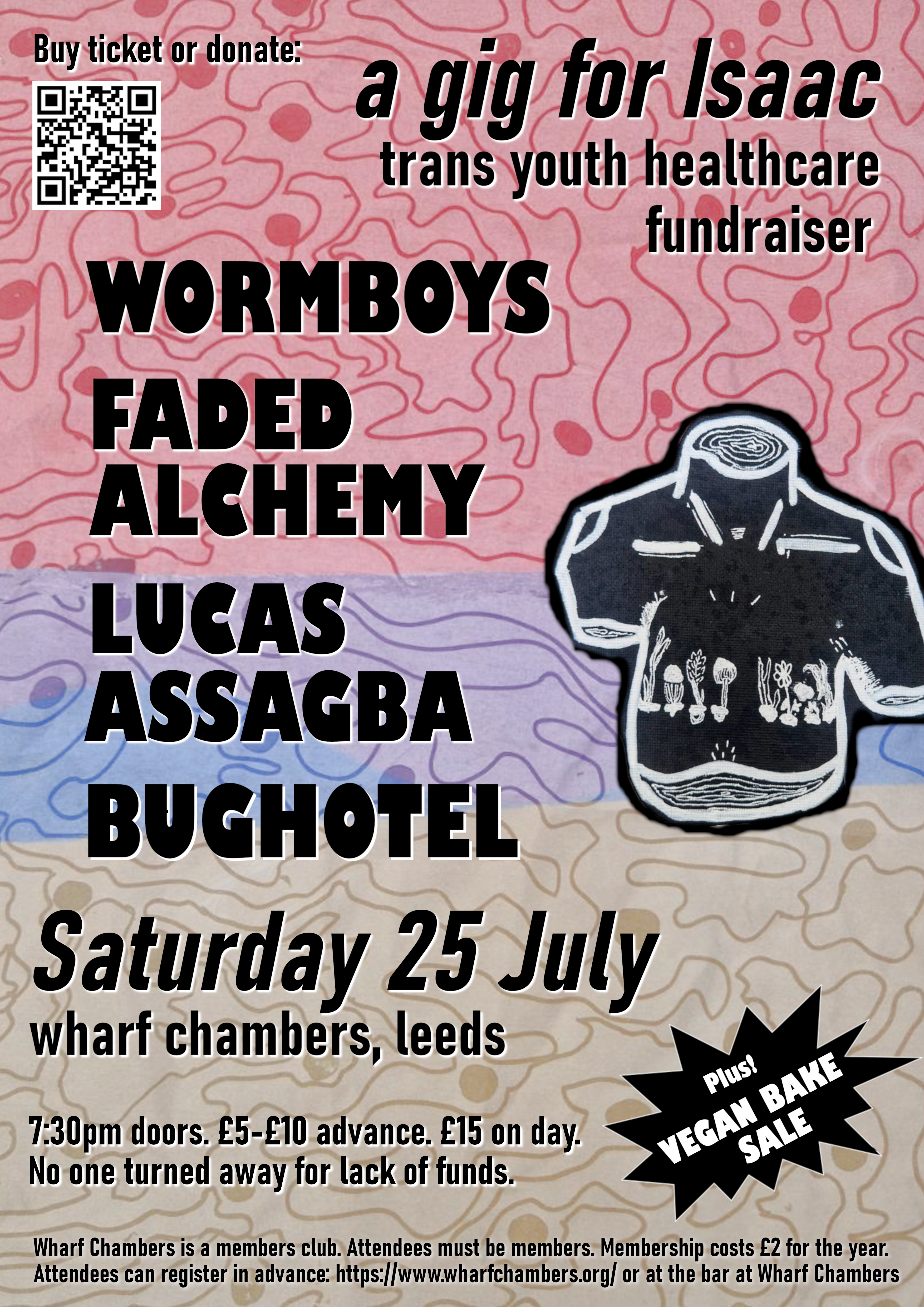
The first of these gigs takes place on Saturday 25th July. I’m actually also co-organising this one, as part of the crowdfunding efforts for Isaac, a Black trans kid whose family are raising money to pay for his healthcare costs.
We’ll be playing alongside three other brilliant West Yorkshire acts. There’s the alt-rock crew Faded Alchemy, who we played alongside for the incredible We Can Kick It football fundraiser at The Attic; Lucas Assagba,a singer-songwriter who pens biting rock tunes which I’m really hyped to hear live; and bughotel, who plays lofi folky indie music which has just got better and better since we last shared a stage a couple of years or so back.
We’re selling tickets on a sliding scale: £10 standard, with alternative rates for people on low income (£5) and those who can afford to give a bit more (£20). We’ll be charging a bit more on the night, but also no-one will be turned away for lack of funds.
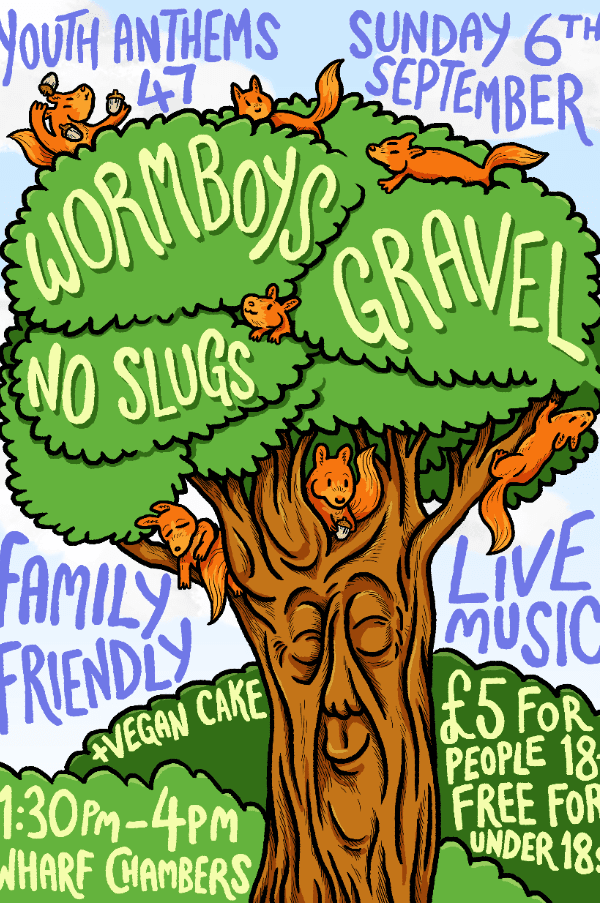
The second gig will be on Sunday 6th September. I’m very excited that we have been booked for a Youth Anthems show, as this long-running series of family-friendly gigs really is a Leeds institution. I really admire that the organisers create this regular space for people of all ages to watch live music together, and respect their commitment to the idea that all kinds of music are appropriate and relevant for children to enjoy.
For this matinee show, we will be playing alongside indie-punks Gravel, who also feature wormboys drummer Jake on the skins (he’ll be having a busy night!), plus electro-pop artist No Slugs, for that maximum garden vibe.
It’s a bargainous fiver for adults, and free for under-18s to attend (when accompanied by an adult). The organisers say over half the tickets have sold already though, so get in there quick if you’re hoping to come!
Like I said, there’s a lot more coming up for wormboys, both over this summer and beyond, so keep an eye out!
If you’d like to follow when I’m performing live, why not subscribe to my blog using the handy form below? Alternatively, I’ve set up a shiny new see me perform page, for people who’d like to keep track of my band, DJ, and spoken word gigs.
I have a new peer-reviewed academic article out in the International Journal of Transgender Health, co-authored with my colleagues Cal Horton, Jaimie Veale, Lou Kerley, and Ken Pang.
The article looks at a range of questionnaires which are in common use internationally in trans youth healthcare. These are designed as a type of data collection tool known as “Patient Recorded Outcome Measures”, or PROMs, in which patients are asked direct questions about their feelings and experiences, to track the outcome of specific treatments.
PROMs are common across healthcare and mental health interventions more generally. You may have experienced this yourself if you have ever seen a therapist, for instance. A widely-used example is GAD-7. This invites patients or clients to use a numerical scale to rate how often they have felt bothered by particular problems, such as “feeling nervous, anxious or on edge”, or “feeling afraid as if something awful might happen”.
If a patient or client fills out a questionnaire such as GAD-7 both before and after receiving a treatment or therapeutic intervention, the care provider can – in theory – test how successful their intervention has been.
In trans healthcare, PROMs have historically been used by clinicians for research purposes, as well as for tracking individual outcomes. This has often been problematic, especially when patients are presented with a great many questions, or where these questions are experienced as pathologising or intrusive. For example, in the mid-2010s the Nottingham Centre for Transgender Health notoriously subjected new patients to27 pages of apparently mandatory questions, including about seemingly random topics such gaming. This caused a great deal of stress and confusion for people seeking care at the clinic.
However, with specialist trans healthcare provision increasingly facing political threats, many clinics currently present PROMs as necessary to demonstrate the benefits of the care they provide. With this in mind, Cal Horton set out to examine 36 PROMs used in trans youth healthcare, assessing them according to four aspects of pathologisation (authenticating transness, intrusion, delegitimisation, and transnormativity) as well as over-assessment. They then brought their findings to our research team, and we wrote them up collectively. We found that both pathologisation and over-assessment were widespread across a majority of these PROMs. For example:
“Tool BI2 asks children to rate how happy they are with 26 body parts, asking which body parts they would like to surgically change, including body parts that cannot be changed through medical intervention (e.g. hands). These questions do not adopt a trauma-informed approach, and many may be experienced as abusive. Tool BI1, for example, asks how children like to pee and how they feel about looking at their body naked, questions which are clinically unnecessary and likely to be experienced as a significant intrusion of privacy by service users.“
The central argument of our article is that numerous commonly-used PROMs are impacted by a wider legacy of pathologisation in trans health, in which young people especially were treated as objects of clinical curiousity, rather than subjects of care. Since these PROMs are well-established and scientifically “validated”, they continue to be used in clinics which profess to practice forms of affirmative care. We therefore named these “pathologising legacy measures”, and caution against their continued use.
We do recognise that many clinics continue to use pathologising legacy measures out of a genuine desire to evidence necessary, life-saving care in an increasingly hostile political environment. Our ultimately question to these clinics is: at what cost?
Did you appreciate this post? Want to read more?
Subscribe now to receive new posts for free whenever I write them.